
Are we selfish enough?

are we selfish enough

We are at our very core, oftentimes, very selfish.  Even in the midst of our most conceptually unselfish acts we are selfish.  We can deny it, we can point our fingers at others comparatively or look to morality for justification, but we cannot holistically evade our selfishness.  Thirst, hunger and the repetition of breath are purposed with our own survival.  When we physically drink, eat and breathe we deprive others.

There is a great deal of talk in this day.  Talk about responsibility, justice, peace, scapegoating, racism, prejudice, oppression, law and order.

There are even those who claim to mentally rise above this level of thinking to discuss concepts more pragmatically.  This dialogue often includes such notions as rational lies, generalizations, meta-programming and the list goes on.  Frequently such discussions fail to evade theory, mostly due to the theoretical approaches inherent to science.  Regardless of the approach, we seek evidence and proof to use as a cornerstone for justification.

You are a product of your encounters, actions, reactions and experiences.  Your thoughts are a product of your existence.  To think that you cannot control your own thoughts is perilous, and to believe you can control the thoughts of others is a fallacy.

There are those who turn to spirituality, religion and morality, in an attempt to avoid the delusions of man.  Yet are taught by men.  Men who created the language which is used as justification.  Ordained…chosen…vessel.  By any and all means seek your inner peace.  Truly realizing your effort, allows you to understand the powerless nature of your tools, when applied to others through you.  It’s okay…regardless of their origin, they are your tools.

Notwithstanding your beliefs regarding our creation, we are the captains of the creation of this moment.  Education is not teaching; education is learning.  However, a poor education is in fact influenced by a lack of resources.  Such resources are independence, motivation, determination, vision and fortitude.  There are so many questions, but I only have one.  Why does our selfishness often elude our desire to learn?

We are random at the atomic level.  We are never going to “fit” on this earth.  Even a snapshot of a moment in time is history, even at the instant it was taken.  There is discussion of a movement.  We are movement.  Moving about this land…blood moving through our veins.  When you speak of a movement, you are speaking of joining.  We join together based on our thoughts and the thought that our thoughts allow us to relate.  The thought that our power and justification increases with number.  The fact is that you are more comfortable with yourself when you join with others.

Whatever your path you must recognize, understand and harness your own selfishness.  Personally, seek prosperity and pursue happiness.

We often, within an instant, say so much and yet say nothing, as I myself have done in this moment.  Today, I am thankful for my selfishness, as for it, I owe this day.

Atlas Concepts, LLC_Jordache Williams

Jordache Williams is currently based in Rock Hill, SC and is a Licensed Professional Counselor with Atlas Concepts, LLC.
Well…are they?

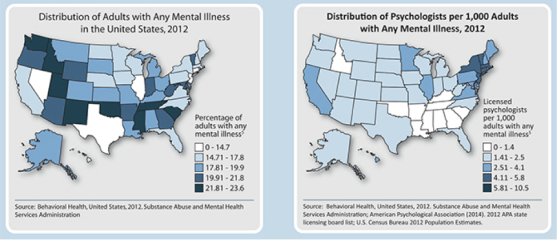
I love new information, and it’s especially helpful when that information includes numbers and graphics.  For instance, the American Psychological Association (APA) recently published results from the Center for Workforce Studies via www.apa.org entitled “Are psychologists in the states that have the most mental illness?”  This article included the graphic below.

Fields of Knowledge Blog_APA Mental Illness graphic

APA, November 2014, Vol 45, No. 10

Granted there are over 200 words that accompanied this graphic, but for me this information raised more questions than answers.  I invite you to take a look at the article yourself as it may speak to you differently.  Having personally conducted research, I can attest to the often arduous nature and inevitable error of that process and understand the power of research that prompts questions.  In that light, I am sharing the inquisitions which rose to mind as I perused the information presented.  I do so in part, with the hopes that others, with interests, resources and ability, can take hold of the lit torch.

The easy questions are often “Why?”  If, when you look at the graphic above, you feel that psychologists are not employed where they are needed, or if you are wondering why people are more mentally ill in a distribution, which appears to be a serpent traveling West across the United States, then you may ask, why?  Some of the more powerful questions however often begin with “How.”  How would this graphic look based on criteria specified in the Diagnostic and Statistical Manual of Mental Disorders Fifth Edition (DSM-5)?  How do the state boards of psychology collect and record data?  A few other questions that came to mind are: Who reports mental illness to the state boards of psychology?  Psychologists are not the only collective who diagnose these illnesses.  What are the data collection efficiency ratings for each state?  Do state reporting criteria vary from state to state?  Keep in mind also that this study concerns ADULTS with REPORTED mental illness.

The point of all this questioning being an effort to avoid making false generalizations.  For instance, does South Carolina (my state of residence) need more psychologists or better psychologists?  Are we assuming that the presence of psychologists is correlated with a decrease in mental illness?  I would almost guarantee that the numbers reported for licensed psychologists is much more accurate than the percentages shown for adults with mental illness.  This may be the limit of my “admitted” assumptions concerning this study.  I assume this, because reporting and record keeping concerning licensed practitioners strikes me as more manageable information.

Lastly, it is not my desire to poke holes in this valuable information.  This is not David and Goliath.  I was prompted on this particularly day, by this particular article, simply because it provides a great example.  The fact is that social media and the internet at large make information assessable.  Assessable (in most cases) to every internet user. This means that those sharing information have a responsibility but moreoverly those who consume and utilize such information must do so responsibly as well. It is not responsible to accept everything at face value, and it is likewise not responsible to over scrutinize information merely for the sake of doing so.  It is my hope that recipients of quality information strive or maintain a level of responsibility conducive to interpretations that are of the most value to themselves and those they influence.  The mere fact that this study’s title is presented in the form of a question speaks volumes.  From my perspective, there is nothing misleading about the work; however, you must, as an individual, guard your “storage bin” of information and challenge yourself towards greater levels of understanding.  This often means knowing what questions to ask!

Jordache WilliamsAtlas Concepts, LLC_Jordache Williams is currently based in Rock Hill, SC and is a Licensed Professional Counselor with Atlas Concepts, LLC.